
Rush at Madison Square Garden: A Concert Worth Traveling For

Two blocks of sidewalk. That’s the entire outdoor portion of getting from a Midtown hotel to your seat at Madison Square Garden.
That sounds like a small thing until you’ve done the alternative. Two blocks to the subway, two stops downtown, then up the escalator from Penn Station and you’re in the building. No parking garage, no surge pricing, no twenty-minute walk across a stadium lot in the dark with your shoes soaked. For a trip we’d built around one concert, the last leg took about fifteen minutes and cost less than a coffee.
We’d been in New York for a week by then. Yankees, Central Park, Ellis Island, a couple of other shows. Rush at the Garden was the night we’d planned the rest of the trip around, and it was the one carrying the most expectation, because we’ve been listening to this band for forty years and there was a real chance it wouldn’t hold up.
It held up.
Getting there: the easiest arena in America
If you’re flying into New York for a concert at MSG, stay in Midtown and take the subway. That’s the whole tip.
The Garden sits directly on top of Penn Station, which means the A, C, E, 1, 2, 3, and every commuter line into the city delivers you to a staircase that ends at the arena’s doors. Nothing else in the country works this way. Even venues with good transit — the United Center, Kia Forum — still leave you outside, walking. Here you never see the sky.
Insider tip: don’t Uber. Eighth Avenue at 7:30 on a show night is a parking lot, and you’ll pay surge rates to sit in it while people who took the 1 train walk past your window.
On the way out: ignore the pedicabs. They stack up outside the exits and they’re very good at making a ride sound like it’ll cost a few dollars. One of our group paid $300. You are standing directly on top of Penn Station and the subway is one level down. Take the train.
Madison Square Garden runs a tight room
Sold-out arena shows usually start with a line that disappears around a corner, and ours looked like it was going to.
It didn’t, because MSG’s staff were working the line. Instead of letting one entrance back up while another sat empty, employees walked the approach and waved people toward whichever checkpoint was moving. We were through in a few minutes on a night when about twenty thousand people showed up inside the same half hour.
Inside was the same story. The concession staff were in a genuinely good mood, joking with people while they poured, which is not something you can say about every arena in July. Ushers pointed rather than shrugged.
There was one thing nobody warned us about. At most events, the women’s restroom lines run down the concourse while the men are in and out in ninety seconds. Rush inverted it completely. It was almost all men in that building. The men’s line ran back past two sections while women walked straight in, which is the reverse of every other arena show we’ve been to. If you’re going with a group, send the guys out early.
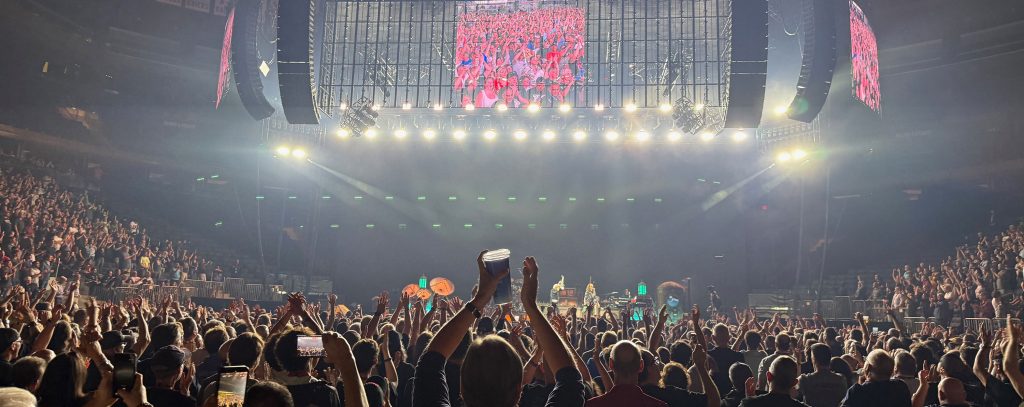
The screen is the show
Rush hung an enormous rectangular LED panel above the stage, and it moves.
Through the night it traveled forward and down, sometimes hovering over the band, sometimes dropping to the front edge of the stage so the musicians were playing behind it. The panel is semi-transparent when it’s dimly lit, so you could see Geddy and Alex through the graphics. Then it would go full brightness and become a solid wall, and the band would vanish into whatever was rendering on it. Behind them, a second full-width display ran its own material, and the two surfaces were programmed to work together rather than compete.
The production quality is the closest thing we’ve seen to Sphere outside of Las Vegas. That’s not a comparison we make casually — we’ve been to Sphere — and no, a rectangular panel in an arena is not a wraparound dome. But the design philosophy is the same one: the visuals exist to give each song its own identity, not to project a close-up of the guitarist’s hands onto a jumbotron. Every track looked like it had been art-directed individually.
It never buried the band, which is where most productions this size go wrong.
Geddy and Alex play like the last decade didn’t happen
Both men are in their early seventies. We went in expecting some accommodation for that — slower tempos, a shorter set, maybe a few keys dropped.
There wasn’t any.
What we kept watching was their hands. Alex’s fretwork and Geddy’s bass runs have humbled players a third their age, and the two of them were getting through it at full speed without any visible effort. More than once we caught ourselves ignoring the screens completely to watch the fingerboards. Their playing hasn’t aged at all.
If you didn’t know Rush had stepped away from the road, nothing about this performance would tell you. They played like a band that never stopped.
Two guys still trying to crack each other up
The best moment of the night had nothing to do with the music.
During “Tom Sawyer,” Alex wandered over to Geddy’s microphone and started mock-singing into it, trying to break him mid-verse. Geddy’s response was to bring both hands up flat against the side of his face, blinders on a racehorse, walling Alex out of his sightline so he could get through the line. It did not work. You can watch him lose the fight from behind his own hands while the verse keeps going.
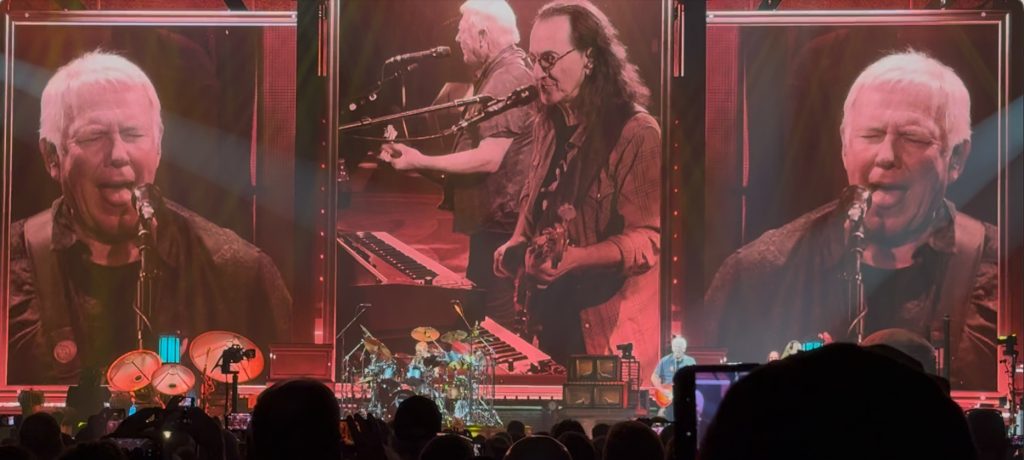
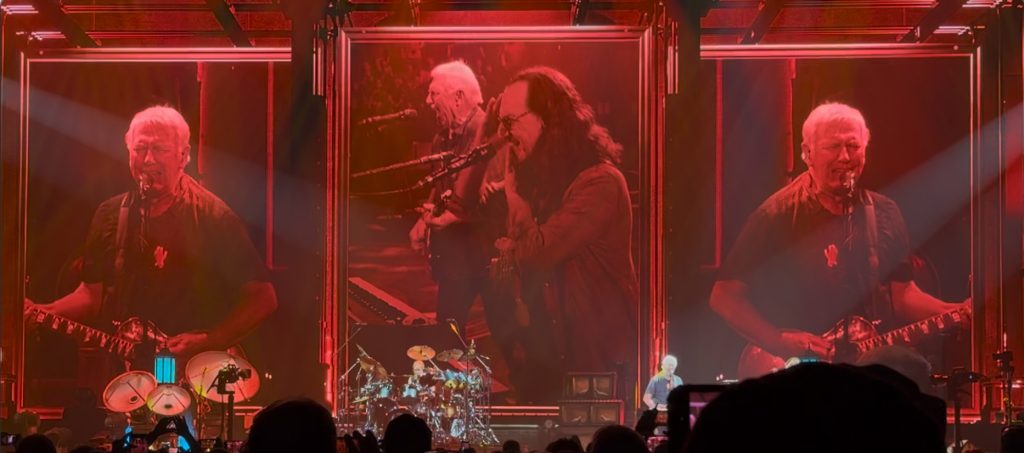
Geddy was also wearing a T-shirt that appeared to show Alex in a pink tutu, mid-ballet pose. Fifty-plus years into a working relationship, and these two are still operating like eighth-graders in the back row trying to make each other break.
You can program lights. You can’t program that, and it’s the part of the show that stays with you.
Anika Nilles has the hardest job in rock
Nobody replaces Neil Peart, and Anika Nilles isn’t trying to.
What she’s done instead is study him. The technique is obvious from the first fill, but what got us was how carefully she learned his specific choices — where he put things, the odd counts, the fills that are basically part of the melody on these songs. The crowd knew every one of them. Every time she nailed a fill people recognized, the arena went up before she’d finished it, and that wasn’t applause for good drumming. It was twenty thousand people acknowledging Neil.
The Neil Peart tributes don’t overstay. Three moments across two and a half hours, none of them a speech.
Nobody on the floor sat down
Not once. From the opening number through the encore, the floor stayed up — singing, air-drumming through the instrumental sections, doing the thing Rush audiences have always done where a riff arrives and several thousand people react like it’s a personal message.
For a band this deep into its career, the room did not feel like nostalgia. It felt current.
What Rush played at MSG on July 28
Set 1: Xanadu · Limelight · Far Cry · Subdivisions · Freewill · Bravado · Headlong Flight · La Villa Strangiato · Vital Signs · The Spirit of Radio
Set 2: 2112 (Overture / The Temples of Syrinx / Grand Finale) · Distant Early Warning · Red Barchetta · Dreamline · Natural Science · Time Stand Still · Red Sector A · YYZ · The Garden · Tom Sawyer
Encore: By-Tor & The Snow Dog · Working Man
Twenty-four songs. Two Neil Peart tribute collages, the Nixie tube countdown opening the second set, and the South Park introduction before “Tom Sawyer.” The night closed with a taped Peart tribute from Paul Rudd and Jason Segel.
If you’re looking at the tour and wondering whether you’d hear the same thing, that turns out to be a more interesting question than we expected.
ConcertVacay Setlist Analysis
We manually compared every song performed across the first 17 completed shows of Rush’s Fifty Something Tour, removing
production elements, countdowns and other non-musical segments to answer one practical question:
If you’re planning a trip to see Rush, what are you most likely to hear?
Rush is not writing a fresh setlist each night. Four fixed setlists cycle by night number inside every multi-night stand, which means the night you buy tells you more about the show than the city does.
Twelve songs are locked in
Complete song-frequency breakdown
The final column shows appearances out of 17 completed concerts.
- 2112 Part I: Overture17 · 100%
- 2112 Part II: The Temples of Syrinx17 · 100%
- 2112 Part VII: Grand Finale17 · 100%
- Bravado17 · 100%
- Limelight17 · 100%
- Subdivisions17 · 100%
- The Spirit of Radio17 · 100%
- Time Stand Still17 · 100%
- Tom Sawyer17 · 100%
- Working Man17 · 100%
- Xanadu17 · 100%
- YYZ17 · 100%
- Red Barchetta15 · 88%
- Freewill12 · 71%
- Vital Signs12 · 71%
- Witch Hunt11 · 65%
- Closer to the Heart10 · 59%
- La Villa Strangiato10 · 59%
- Anthem9 · 53%
- By-Tor & The Snow Dog9 · 53%
- Dreamline9 · 53%
- Headlong Flight9 · 53%
- Red Sector A9 · 53%
- 2112 Part III: Discovery8 · 47%
- 2112 Part IV: Presentation8 · 47%
- 2112 Part V: Oracle: The Dream8 · 47%
- 2112 Part VI: Soliloquy8 · 47%
- Finding My Way8 · 47%
- The Camera Eye8 · 47%
- The Trees8 · 47%
- Distant Early Warning7 · 41%
- Far Cry7 · 41%
- New World Man7 · 41%
- The Garden6 · 35%
- A Passage to Bangkok5 · 29%
- Animate5 · 29%
- Leave That Thing Alone5 · 29%
- The Analog Kid5 · 29%
- Caravan4 · 24%
- Natural Science4 · 24%
- The Anarchist4 · 24%
- The Pass3 · 18%
- A Farewell to Kings2 · 12%
Twelve songs have been played at all seventeen shows: Xanadu, Limelight, Subdivisions, The Spirit of Radio, Bravado, Time Stand Still, Tom Sawyer, Working Man, YYZ, and the Overture, Temples of Syrinx and Grand Finale sections of 2112. Buy any ticket and you get those.
Thirty-one more rotate around that core. A few land most nights. Several show up half the time. None of them has been played only once, which is worth saying plainly: there are no true rarities on this tour, only songs that belong to a different night than yours.
The rotation is not random.
The rotation has a schedule
Rush built four setlists and assigns them by night number.
In Los Angeles, Fort Worth and Chicago, night one is the same show in all three cities. Not similar — the same songs. So is night two, and so is night three. New York's first two nights matched the night-one and night-two setlists with a single substitution each: Headlong Flight for Caravan on July 28, and Caravan back in for Headlong Flight on July 30. Night three didn't even do that. On August 1 the band played the night-three setlist exactly as Chicago got it twelve days earlier, in the same order, top to bottom.
Which night matters more than which city
A four-night cycle emerged across the tour
The comparison below uses song pools. Production elements and tribute interludes are excluded.
| Residency night | Inglewood | Fort Worth | Chicago | New York |
|---|---|---|---|---|
| Night 1 | Jun 7 Exact match | Jun 26 Exact match | Jul 16 Exact match | Jul 28 One-song swap Headlong Flight in for Caravan; 23 selections shared with the template. |
| Night 2 | Jun 9 Exact match | Jun 28 Exact match | Jul 18 Exact match | Jul 30 One-song swap Caravan in for Headlong Flight; 27 selections shared with the template. |
| Night 3 | Jun 11 Exact match | Jul 11 Exact match Postponed from June 30 after Geddy Lee was diagnosed with laryngitis and bronchitis | Jul 20 Exact match | Aug 1 Exact match |
| Night 4 | Jun 13 Exact match | Jul 13 Major variation La Villa Strangiato, Red Barchetta, Witch Hunt in for A Farewell to Kings, Distant Early Warning, New World Man, The Garden; 24 selections shared with the template.Postponed twice: originally June 24, moved to July 2 after travel delays, then to July 13 | Jul 22 Exact match | Pending Not played yet |
Across the completed four-night runs, each residency position repeated the same song pool city to city. That is strong evidence the setlists were planned by night number rather than assembled per show.
The Madison Square Garden nights each differ from the established template by at most one substitution, and the two swapped songs traded places between nights one and two.
The 2-show Mexico City stop did not use the standard Night 1 and Night 2 templates. It ran T3 then T2, which suggests shorter residencies follow their own sequence.
Which night you attend matters more than which city.
The clearest case is 2112. On odd-numbered nights of a stand Rush plays three movements. On even-numbered nights they play all seven. Seventeen shows, no exceptions. That one decision accounts for the entire gap between a 24-song night and a 28-song night — the longer shows aren't longer concerts so much as concerts containing four extra movements of the same piece.
One show has broken the pattern. Fort Worth on July 13 came in three songs short of its template, and it had a reason: Geddy Lee was diagnosed with laryngitis and bronchitis, two Texas dates moved back by almost two weeks, and the July 13 show had originally been scheduled as the opening night of that run rather than the closing one.
What changes from night to night
Where the setlists really changed
The 12 selections played at every concert are the backbone. These 31 rotating songs and 2112 movements give individual nights their identity.
Near-Core Favorites
10–15 appearances
-
Red Barchetta 15 of 17
-
Freewill 12 of 17
-
Vital Signs 12 of 17
-
Witch Hunt 11 of 17
-
Closer to the Heart 10 of 17
-
La Villa Strangiato 10 of 17
Half-the-Tour Rotations
7–9 appearances
-
Anthem 9 of 17
-
By-Tor & The Snow Dog 9 of 17
-
Dreamline 9 of 17
-
Headlong Flight 9 of 17
-
Red Sector A 9 of 17
-
2112 Part III: Discovery 8 of 17
-
2112 Part IV: Presentation 8 of 17
-
2112 Part V: Oracle: The Dream 8 of 17
-
2112 Part VI: Soliloquy 8 of 17
-
Finding My Way 8 of 17
-
The Camera Eye 8 of 17
-
The Trees 8 of 17
-
Distant Early Warning 7 of 17
-
Far Cry 7 of 17
-
New World Man 7 of 17
Occasional Surprises
4–6 appearances
-
The Garden 6 of 17
-
A Passage to Bangkok 5 of 17
-
Animate 5 of 17
-
Leave That Thing Alone 5 of 17
-
The Analog Kid 5 of 17
-
Caravan 4 of 17
-
Natural Science 4 of 17
-
The Anarchist 4 of 17
Deepest Cuts
2–3 appearances
-
The Pass 3 of 17
-
A Farewell to Kings 2 of 17
“Red Barchetta” has appeared in 15 of 17 shows, the closest thing to a nightly guarantee outside the 12-song core.
The four middle movements of 2112 appear together or not at all. Odd-numbered nights of a residency get the abbreviated suite; even-numbered nights get all seven parts. That single decision accounts for most of the gap between a short show and a long one.
“A Farewell to Kings” has appeared 2 times, making it the rarest selection in the first 17-show sample.
Strip out the twelve songs everybody gets and what's left is the part that changes.
A Passage to Bangkok, Animate, Leave That Thing Alone and The Analog Kid are night-two songs. They turn up on the second night of a stand and almost nowhere else. A Farewell to Kings, The Anarchist and The Pass belong to night four. Two people who saw the same city on different nights genuinely saw different shows, and now you can see exactly which ones.
None of this makes a first night the lesser ticket. It makes it a different ticket.
Want the complete data?
View our companion reference page: Rush Fifty Something Tour Setlist Analysis: Complete Data Tables
Should you see them twice?
See two nights of the same stand before you see two cities.
A second city on a matching night number gets you close to the same show. A second night in the same building gets you a different one, at a fraction of the travel. That's the whole finding in one sentence.
Rush can change the rotation whenever they like, and seventeen shows is seventeen shows. But it has held every time so far.
Best for: anyone who's been waiting years to see Rush, first-time fans wanting the complete production, and longtime listeners curious to hear how the band has reimagined these songs for 2026.
Skip it if: your enjoyment depends on hearing one specific deep cut. Check recent setlists before purchasing tickets, because the rotating songs continue to evolve.
Coming back was never in question. Which night was. Seventeen shows of data later, we know how to pick.
Planning to catch Rush on another stop of the Fifty Something Tour?
Browse upcoming dates, compare ticket options across vendors, and find hotels near the venue---turn the show into the trip.
Plan the trip
Toronto is a four‑night stand. Pick the night, not just the city.
Rush plays Scotiabank Arena four times in August. Across the first 16 shows of this tour, the night number of a stand has determined both the length of the show and whether you get the complete 2112. If that holds, here is what each Toronto night is shaping up to be.
A pattern, not a promise. Rush builds each night from a large catalog and nothing stops them changing it — this is what the first 16 shows have done, updated as the tour continues.
All Rush tour dates on ConcertVacay | See the full setlist analysis